Thad Beaumont’s fugue states
The Dark HalfThad Beaumont’s fugue states are periods of altered awareness marked by the return of childhood sparrow sounds, fragmented visions, and writing he cannot fully remember producing. Their importance lies in the way they join a medical history to a developing supernatural connection: at first Thad can treat the birds as an old sensory warning, but the words written during the episodes begin to implicate George Stark and connect Thad to events beyond his conscious knowledge.
Childhood symptoms and their return
At eleven, Thad suffered increasingly severe headaches after school resumed in 1960. Before the pain came a sound only he could hear, like distant birds; he imagined sparrows gathering on telephone lines and rooftops. Doctors eventually removed a mass from his prefrontal lobe, initially assumed to be a tumor. The mass proved to be part of his incompletely absorbed twin. The medical explanation gives the later episodes a concrete point of origin: the bird-sound had been an auditory sensory precursor associated with the childhood illness, rather than an experience Thad had shared with other people.
Years later, Thad recognizes the old sound when he says that the sparrows are flying again. He explains to Liz that his childhood symptoms had included headaches and that the bird sounds were the sensory precursor of those headaches. He had never considered that part of the episode especially important. Now, however, the sound has returned without the childhood pattern of pain, and it accompanies experiences he cannot readily place within that explanation.
Trance, writing, and missing memory
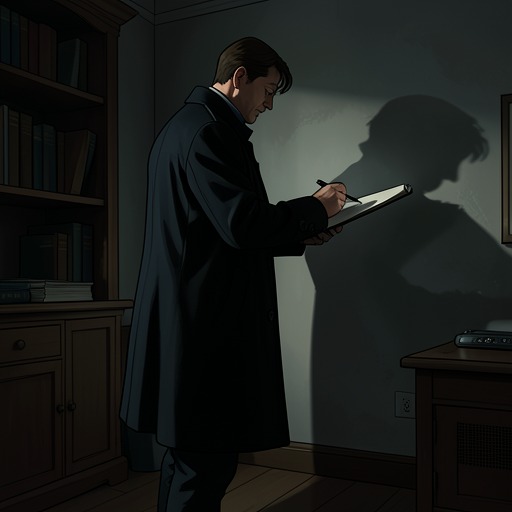
During an episode in his study, the sparrow cries intensify while Thad is working on his novel. He sees a vision of birds gathering across a white sky and collapses into his chair. The episode lasts less than five minutes, but afterward he is sweating, his wrist throbs, and a page on his desk bears writing he does not remember making. The words combine material associated with his dream of Stark with disconnected language. He has no headache, and the writing does not resolve into a clear message for him.
Liz asks whether he was in a trance. Thad reluctantly agrees that he thinks he was, but cannot remember whether he said anything during it. That blank is central to the episodes: they do not provide him with a coherent recollection of what happened, only evidence left behind for him to inspect. The page changes the meaning of the experience from a private sound or vision into an action with a material trace, while leaving Thad uncertain about how much of it he witnessed consciously.
His response is not simply to seek an explanation. After the office episode, he decides not to tell Liz about the writing, telling himself that some secrets may be necessary. He admits, at least to himself, that fear is part of his silence, but also says he is exhausted by repeated attempts to think his way to certainty. The decision gives the fugue states a relational consequence: they unsettle the trust between Thad and Liz even as she tries to understand and respond to what he tells her.
Medical uncertainty and recurrence
Thad makes an appointment with Dr. Hume after the bird sounds recur. He reports two returns of the auditory symptom and mentions his childhood tumor removal, but does not disclose the trance, the writing, or the related writing found at a murder scene in Washington, D.C. He presents a narrower, medically legible account: the old sound has returned, but the headaches have not. Dr. Hume takes the recurrence seriously and orders cranial X-rays and a CAT scan.
Before those results settle the question, another episode occurs in Thad’s university office. The birds begin as separate cries and build into a deafening chorus; a vision of sparrows covering houses and telephone poles accompanies the sound. When Thad comes back to himself, he finds words scrawled on the back of a form for complimentary American literature textbooks. He is sweating and his wrist hurts, but he has no headache. The words seem to him partly drawn from a dream of Stark and partly gibberish. Their disorder does not make the event harmless: Thad fears that they may connect to something he does not want to know, and he resolves to keep this episode from Liz as well.
The medical history remains relevant without fully explaining the later events. When Thad tells Alan Pangborn what has happened, he recounts the childhood headaches and sparrow visions, the return of the sounds, the writing in his office, and his attempt to destroy the form. The childhood operation had removed the unusual tissue in Thad’s brain, but neither the absence of current headaches nor the neurological history accounts for the growing significance of what the fugue states produce.
Connection to George Stark and the murders
The content of the episodes becomes more pointed as the story progresses. After hearing a voice associated with Stark and learning that Miriam Cowley is in danger, Thad tells Liz that he believes the man is Stark. He reports another episode: the sparrows came first, then he wrote on a piece of paper while unconscious. He threw the paper away, but remembers that Miriam’s name was among the words. The episode has thus moved beyond an unsettling recurrence of an old symptom. Its writing appears to anticipate or register a person connected to the unfolding danger, even though Thad cannot recover the act of writing in the ordinary way.
Thad eventually tells Alan the broader account, showing him a manuscript page marked with the words THE SPARROWS ARE FLYING and describing both the office fugue and the discarded writing. He says he knows Stark is involved and gestures toward his own chest. The fugue states therefore function as a form of evidence that is simultaneously personal and difficult to verify: Thad experiences the sound and its aftermath, but what he can offer others is a sequence of recollections, pages, and conclusions that he himself has struggled to trust.
The pattern also changes how Thad understands authorship and selfhood. As a writer, he recognizes that people may not fully understand why they act, and wonders whether fiction is an attempt to impose order on confusion. The episodes sharpen that uncertainty. Writing, normally a deliberate practice through which he makes meaning, becomes something that can occur when he is not fully aware and may carry knowledge he cannot consciously claim.
From private episodes to a larger force
The sparrows eventually appear outside Thad’s fugue states as well. At Gold’s Junkyard and Auto Supply, Thad and Rawlie DeLesseps find the abandoned vehicles covered with birds, which have gathered without Thad hearing them arrive. Their silent presence makes the flock more than a private auditory warning or an image generated during altered awareness. It acts in the shared world, and Rawlie recognizes the birds as psychopomps, linking their appearance to the passage between life and death.
Later, Alan Pangborn encounters a sparrow that lands on his shoulder and steps onto his hand before returning to the flock. The bird’s calm proximity, and the apparent limits of how close the larger gathering comes, make the flock seem selective rather than merely incidental. Thad also finds a clear boundary where the birds occupy the road; one settles on the hood of his car and appears to regard him. He understands that reaching the house requires driving through them. These encounters extend the episodes’ pattern of perception into action: the birds are not only heard or written about but shape where people can go and how they approach Stark.
At the final confrontation, Thad understands the assembled psychopomps as an escort for George Stark back to the land of the dead. The flock gathers around Stark and carries out that passage. In retrospect, the fugue states’ recurring sound, fragmentary images, and writing have prepared Thad to recognize the sparrows as agents in the conflict, not simply symptoms of his childhood illness. Yet their presence also marks the limit of his control: the birds may connect his perception to events, but they do not become instruments he can command at will.